
What is ALS?
ALS, or amyotrophic lateral sclerosis, is a progressive neurodegenerative disease that affects nerve cells in the brain and spinal cord. “Amyotrophic” comes from the Greek language. “A” means no. “Myo” refers to muscle. “Trophic” means nourishment. So, amyotrophic means “no muscle nourishment,” and when a muscle has no nourishment, it “atrophies” or wastes away.
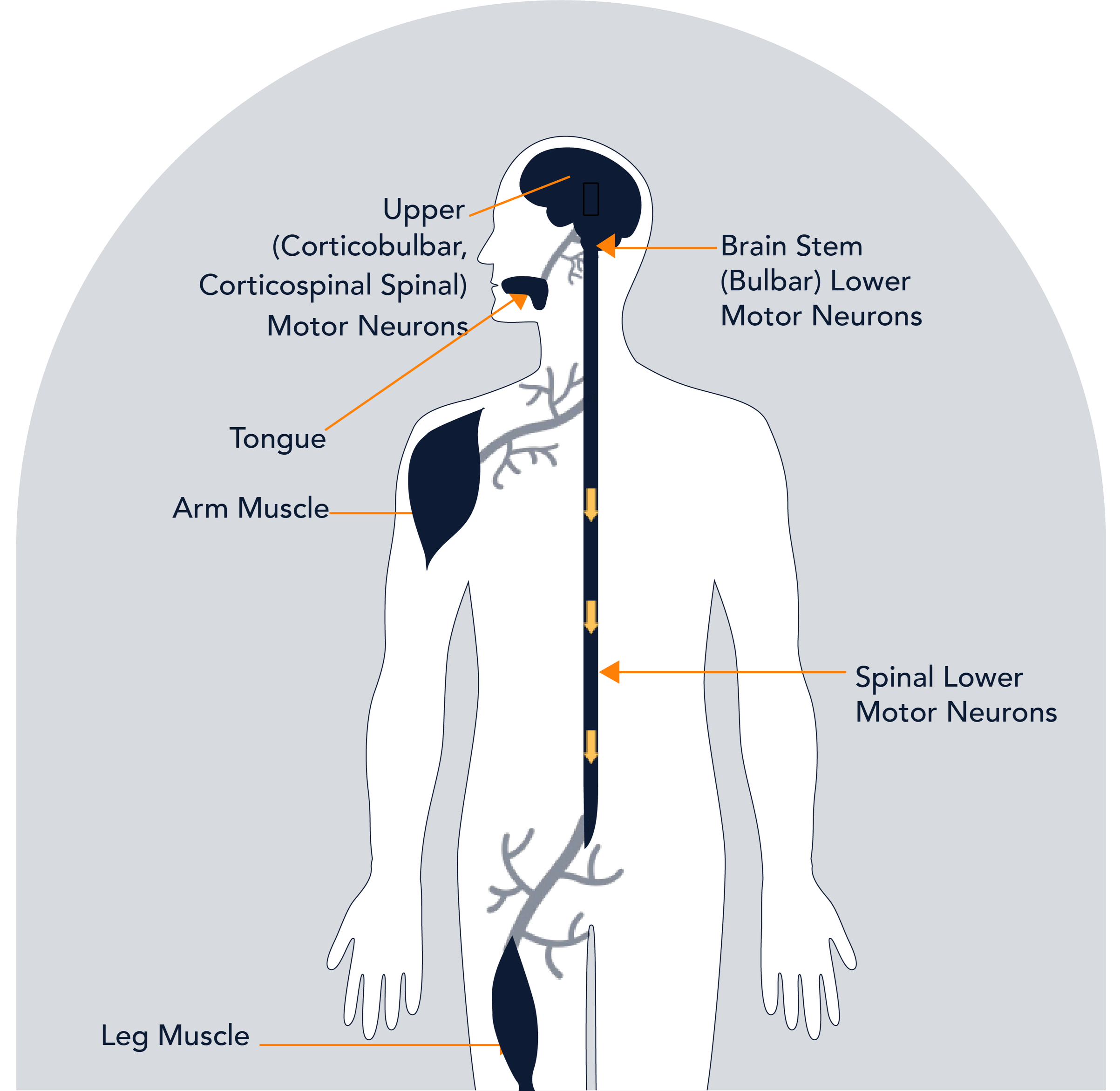
“Lateral” identifies the areas in a person’s spinal cord where portions of the nerve cells that signal and control the muscles are located. As this area degenerates, it leads to scarring or hardening (“sclerosis”) in the region. Motor neurons reach from the brain to the spinal cord and from the spinal cord to the muscles throughout the body. The progressive degeneration of the motor neurons in ALS eventually leads to their demise.
When the motor neurons die, the ability of the brain to initiate and control muscle movement is lost. When voluntary muscle action is progressively affected, people may lose the ability to speak, eat, move and breathe. The motor nerves affected when you have ALS are the motor neurons that provide voluntary movements and muscle control. Examples of voluntary movements are making the effort to reach for a smartphone or step off a curb. These actions are controlled by the muscles in the arms and legs.

Jean-Martin Charcot
French neurologist Jean-Martin Charcot discovered ALS in 1869. While ALS can affect anyone, anywhere, at any time, there are two different ways cases are categorized – with or without family history.
90
%
For about 90% of all cases, there’s no known family history of the disease or presence of a genetic mutation linked to ALS.
5-10
%
For 5-10% of all cases, there’s a known family history of the disease. This is often called familial ALS.
50
%
In families with familial ALS, there is a 50% chance each offspring will inherit the gene mutation and may develop the disease.
THERE IS NO CURE FOR ALS
However, about 10 percent of people with ALS survive for 10 or more years
-
More than 5,000 people are diagnosed with ALS each year
-
2-5 years is the average life expectancy
-
10 percent of cases are inherited through a mutated gene
-
90% of cases occur without a family history
-
Global ALS cases are expected to surge by 40% in the next decade
-
For reasons unknown, military veterans have a higher likelihood of being diagnosed with ALS
COPING WITH ALS
In addition, people living with ALS may experience a better quality of life by participating in patient support groups and seeking treatment at an established ALS Multidisciplinary Clinic (or ALS Center of Excellence) where some of the top ALS experts in the world focus on the early diagnosis and treatment of ALS. Such Centers provide a national standard of best-practice multidisciplinary care to help manage the symptoms of the disease and help people living with ALS live on their own terms for as long as possible.
According to many published papers & clinical studies, those people living with ALS that are treated at an ALS Multidisciplinary Clinic may have prolonged survival and improved quality of life.
Notable individuals with ALS include:
Lou Gehrig, baseball player
Stephen Hawking, physicist
Stephen Hillenburg, “SpongeBob SquarePants” creator
Jon Stone, “Sesame Street” creator
Jacob Javits, U.S. Senator
Jim “Catfish” Hunter, MLB player
Steve McMichael, NFL football player, Chicago Bears
Steve Gleason, NFL football player, New Orleans Saints
Dwight Clark, NFL football player (San Francisco 49ers)
Tim Shaw, NFL football player (Tennessee Titans)
O.J. Brigance, NFL football player (Baltimore Ravens)